Showing posts with label John Coltrane. Show all posts

Jazz In Joint Ownership


The different forms of improvised music - still conveniently collected under the label of jazz - were not, of course, the exclusive property of black musicians at this time. Numerous white musicians also appropriated the heritage of jazz: David Liebman and Richard Beirach, more than anyone else, continued to deepen the heritage of John Coltrane and Bill Evans; Keith Jarrett gave new life to old standards and to the traditional rhythm section in the vein of Bill Evans; Pat Metheny fed his super productions, tinged with pop, Brazilian and country music, with inspirations from Ornette Coleman and Wes Montgomery.

Jazz Of Thufeil - David Liebman.jpg
David Liebman

Black producers, from Quincy Jones to Marcus Miller, have had an undeniable impact in the last decade. But another force since the sixties has been the white jazz musicians who have changed the direction of the sound as well, thanks to personalities such as Michael Brecker, David Sanborn and the guitarist Larry Carlton. These name are always mentioned in this context.

Jazz Of Thufeil - Richard Beirach.jpg
Richard Beirach
Studio work has allowed jazz-rock to become open to a variety of other influences. Jazz has profited commercially from such borrowings.


Jazz Of Thufeil - Marcus Miller Bass.jpg
Marcus Miller; as Bass Player...

Jazz Of Thufeil - Marcus Miller Producer.jpg
... and as Producer
The popularity of Latin music represented a dual appeal; it fulfilled a public demand for upbeat music - evocative of sun and health- as well as responding to a youthful audience concerned with making the most of the positive aspects of its racial diversity.

____________________

The Jazz-Rock Of Miles Davis' Children


Innumerable musicians who were temporarily of Davis' band attempted to prolong that musical experience and hold on to the public won through that contact. Transposing the energy of rock into their bands, they put their savoir faire as jazz musicians to the service of jazz-rock.

Jazz Of Thufeil - John McLaughlin.jpg
John McLaughlin

Jazz Of Thufeil - Mahavishnu Orchestra.jpg
Mahavishnu Orchestra
John McLaughlin, for example, met with great success with his Mahavishnu Orchestra, starting in 1971. He allied a virtuosic writing and incantations  inherited from John Coltrane to a concern with technical performance that excited the rock audience. Mystical, like Coltrane, and fascinated with India, he blended the metric and modal sophisticated of Indian music with the rhythmic and harmonic effectiveness of rhythm and blues.

Jazz Of Thufeil - Jan Hammer.jpg
Jan Hammer
  The pianist Jan Hammer was a pioneer in exploring the phrasing possibilities offered by the first electronic keyboards. The violinist Jerry Goodman attracted the public's attention, and the drummer Billy Cobham gave proof of fascinating technique in music with uneven meters.
Jazz Of Thufeil - Jerry Goodman.jpg
Jerry Goodman

Through their power, speed of execution and impressive equipment,drummers unleashed great excitement.
Now in the forefront of their bands, leaders such as Tony Williams or Billy Cobham often eclipsed the fame of their entourage.

Jazz Of Thufeil - Billy Cobham.jpg
Billy Cobham

This, however, was not the case with Lenny White (drums) and Stanley Clarke (the first great electric bass soloist), who played with Chick Corea's group, Return to Forever. As for Corea himself, who had shared in Miles Davis' first electronics experiments, his keyboard virtuosity and brilliant writing were seductive. Swinging toward the Spanish with the addition of the guitarist Al Di Meola, the strong Latin feeling in his repertoire delighted the public.

Jazz Of Thufeil - Lenny White Stanley Clarke RTF.jpg
Lenny White & Stanley Clarke, Return To Forever (1975)


Jazz Of Thufeil - Al Di Meola Chick Corea RTF.jpg
Al Di Meola & Chick Corea, Return To Forever (1975)
Jazz Of Thufeil - Return To Forever.jpg
Return To Forever (L-R) Lenny White, Chick Corea, Al Di Meola, Stanley Clarke

Also emerging from Miles Davis' universe, Herbie Hancock created a group that was more profoundly anchored in the popular African-American tradition. Leaning on the deep-sounding 'drop' of the drummer Harvey Mason, Hancock's music became funkier than Davis'. More accessible to the general public, it was enormously successful, particularly with the album that takes its title from the name of the group: Head Hunters.

Jazz Of Thufeil - Herbie Hancock Paul Jackson Headhunters.jpg
Herbie Hancock & Paul Jackson, Headhunters

Like Chick Corea, who was now swinging between acoustic and electronic music, Hancock alternated successful inroads into 'electrofunk' with returns to formulas close to the spirit of the Miles Davis quintet of the sixties.

______________________

The Endurance Of Miles Davis


Throughout the sixties Miles Davis was haunted by the short time (1958-9) Bill Evans and John Coltrane were both in his group. Twice he replaced his pianist, first with Wynton Kelly, then with Herbie Hancock, who combined the refinements of Bill Evans and the more vigorous statement of the funk pianist. On the other hand, it took him several years before he found the replacement for John Coltrane in the person of Wayne Shorter.

Jazz Of Thufeil - Wynton Kelly and Gene Ramey.png
(L-R) Wynton Kelly, Gene Ramey (bass)

When he did, a new era opened up for Miles Davis, marked by recordings that today are considered to be masterpieces of modern jazz for small groups. Thus, from one year to the next, E.S.P, Miles Smiles, Nefertiti and Miles In The Sky, among others, raised and then answered a series of musical questions. Davis' quintet was, at that time, a truly experimental group - each entrance into the studio would bring new development.
  
Jazz Of Thufeil - Herbie Hancock.png
Herbie Hancock

Jazz Of Thufeil - Wayne Shorter.png
Wayne Shorter

In this way, the rhythm section exploited the heritage of Bill Evans trio: Herbie Hancock (piano) was suggestive; Ron Carter (bass) no longer stated the tempo systematically but imposed a powerful sense of pulsation; Tony Williams (drums), sophisticated and daring, freed himself from accompanist's role. he took the Elvin Jones' poly rhythm, gave it air, and diversified it by superimposing figures conceived in binary measures. In session after session, the quintet explored a repertoire dependant on Wayne Shorter's innovative ideas. Shorter, a master improviser, showed Davis a way to widen the range of liberties allowed by modal playing even further. On the stage Davis stayed with a more conventional program, but the risks he took in the studio changed the way the public saw the band.
  
Jazz Of Thufeil - Miles Davis Quintet.png
Miles Davis Quintet
Jazz Of Thufeil - Ron Carter.png
Ron Carter


Like the innovations of Charlie Parker twenty years earlier, these measures, ground-breaking at the time, have become the conventions of small-group jazz

Jazz Of Thufeil - Tony Williams.png
Tony Williams

____________________

'A Barroom Piano Player'


This is how Bill Evans was appraised when free jazz exploded. Later, the critics realized that circumspectly and without being the leader of any particular current, he had led as profound a revolution as John Coltrane or Ornette Coleman. Without ever systematizing the contributions of modal jazz (which he helped found), he drew deep inspiration from it. His work as a composer surely borrowed from his charms of the old standards, of which he was very fond; but he lightened their often limited harmonic frames and broadened the field of melodic possibilities.
  
Jazz Of Thufeil - Bill Evans  beard.png
Bill Evans


More significantly, due to the quality of his touch, he inaugurated a new approach to the jazz piano, which, until that point, had primarily been used as a percussion instrument. Bill Evans was not a barroom piano player; he was a concert pianist. His trio (piano, double bass, drums), which he used as a chamber orchestra, broke new ground.
  
Jazz Of Thufeil - Scott LaFaro Bill Evans Paul Motian.png
Scott LaFaro, Bill Evans, Paul Motian


From 1960 to 1961, Scott LaFaro (bass) and Paul Motian (drums) freed themselves from their role as mere accompanists and became soloist on an equal footing with the piano; the three participated in a triangular conversation. Collective and interactive, improvisation became more than ever a question of mutual listening and finding one's own place while treating the others' with respect. The revolution led by John Coltrane with sound and fury was conducted by Bill Evans' trios with a delicacy that evoked the intimacy of Claude Debussy.

jazz Of Thufeil - Steve Swallow, Walter Perkins, Art Farmer, Jim Hall.png
(L-R) Steve Swallow, Walter Perkins, Art Farmer, Jim Hall
  
Thus, along with such contemporaries as Jim Hall, who shared his concerns, Bill Evans left his mark on generations of musicians: on pianist, of course (Keith Jarret, Paul Bley and Chick Corea), but also on drummers (Jack DeJohnette), bass players (Gary Peacock), and saxophone players, trumpet players and bandleaders.

Jazz Of Thufeil - Gary Peacock, Keith Jarret, Jack deJohnette.png
Gary Peacock, Keith Jarret, Jack DeJohnette (2012)

____________________

On The Fringes Of The Free


In its rush to explain history, jazz criticism has often been mistaken in presenting the explosion  of free jazz and the supremacy of improvisation over writing as the sole significant developments of the sixties. 

Jazz Of thufeil - Horace Silver.png
Horace Silver

After this decade the history of jazz no longer moved in one direction; many tendencies showed themselves on the fringes of free jazz. Besides Charles Mingus and Eric Dolphy, other, influenced by Horace Silver, John Coltrane, Miles Davis and Ornette Coleman (some recording under the Blue Note and Candid labels), declared themselves outside of any identifiable group. Musical Language advanced, feeding both the autonomy of the improviser and the emancipation of rhythm. The players of 'the new thing', involved in a political struggle, embraced their cultural heritage, but, in contrast, a large number of their contemporaries demanded the freedom to control, master and assimilate what they wanted from the cultural environment at large, from classical music to free jazz.

Jazz Of Thufeil - Blue Note LP.png
Sonny Clark Sextet Blue Note LP

____________________

The Tenor Saxophone, Mouthpiece Of The Black Community In Revolt


John Coltrane exerted an unequaled fascination on the young generation. His predominant instrument, the tenor saxophone, was particularly meaningful to them. In the fifties, 'the howling' saxophones  of rhythm and blues had reinforced the virile image of the tenor; this image allowed for the most direct expression,from the low, violent-tempered register to the exasperation expressed by the shrill.

Jazz Of Thufeil - Archie Sepp.jpg
Archie Shepp
 
During the period of free jazz, three other instrumentalist in particular used it for the requirements of their respective projects. Pharoah Sanders continued the work of John Coltrane, with whom he had been associated for some time. He developed an extremely mystical and incantatory approach and borrowed exotic musical forms and instrument from many non-Western musical sources. Archie Shepp turned himself into a historian of African-American music through his emotional re-readings of John Coltrane, Duke Ellington and Charlie Parker, and soul, blues and gospel music. Albert Ayler dared to scream. Mixing the most naive melodies for children with densely resonant fabrics, he placed conventional language beyond expression, favoring the immediacy of feeling.


Jazz Of Thufeil - Albert Ayler.jpg
Albert Ayler

____________________

Ornette Coleman, Herald


At the end of fifties, however, Ornette Coleman's star rose higher than John Coltrane's. This young saxophone player from the West Coast had already rejected the harmonic aspect of Charlie Parker's legacy: he wanted to retain only its essence. 'Let's play the music and not its background,' he declared. To him technique was secondary; in his eyes only the feeling and authenticity of expressions counted.
The lyricism of his melodic playing was startling and, paradoxically, elusive.

Jazz Of Thufeil - Ornette Coleman.jpg
Ornette Coleman

  The 'harmolodic theory' he was to develop over the years escaped musicologists' understanding; it came from philosophic - better yet, poetic - rather than from technical concerns. His art was reminiscent of the authenticity of slaves' 'field hollers', which outside observes have never managed to describe in the vocabulary of European musicology.

 The forms he borrowed made frequent reference to blues or structures inherited from musical comedy, but his 'Blues Connotation' in eleven and half bars is more evocative of uncertainties of the early blues players than of the academic twelve bar.

Jazz Of Thufeil - Shape Of Jazz To Come.jpg
The Shape Of Jazz To Come - Record by Ornette Coleman
 
  Many bop musicians took offense at these ideas, which put their entire mode of thinking into question. However, the support Ornette Coleman received from John Lewis and some West Coast musicians allowed him to record his first discs. They looked like a manifesto: Something Else!, Tomorrow is the Question and The Shape of Jazz to Come. On 21 December 1960 he made a recording with a double quartet.
The new formula marked the beginning of an epoch: the new album was called Free Jazz, relating to the intention of drawing form and musicality from the apparent chaos he presented. To most musicians - and the public - Coleman's music did sound like chaos.

____________________

The Road To Freedom


John Coltrane was the master of modern jazz in the early sixties. He was a leader for angry young black musicians who wanted to re-appropriate their music from the dominant white culture. Against a background of the civil right movement, jazz musicians rejected the aesthetic criteria of mainstream American society and invented something new that would be called free jazz.


Jazz Of Thufeil - John Coltrane.jpg
John Coltrane

The saxophone player John Coltrane was a calm, reserved, contemplative man, completely absorbed by his music and, even more, by the philosophical and mystical problems he sought to solve through his music. Although annoyed by Coltrane's incessant questions, Miles Davis asked him to join his quintet in 1956. Perhaps he understood that one of the great figures of jazz would emerge from these interrogations. From his first steps with Davis until his death, Coltrane never stopped questioning his art.

Jazz Of Thufeil - Coltrane Adderley Davis Evans.jpg
(L-R) John Coltrane, Cannonball Adderley, Miles Davis and Bill Evans; Kind Of Blue Recording Session


With Giant Steps

In 1957, during a stint at the Five Spot in New York City with the Thelonious Monk Quartet, Coltrane was inspired by the unusual piano accompaniments. When Monk would leave the stage, Coltrane would take advantage of this time to explore new harmonic processes during long improvisations.

Jazz Of Thufeil - Monk Coltrane LP.jpg


 In 1958 Coltrane joined Miles Davis' new sextet, which recorded his masterpiece, Kind of Blue, a year later. Coltrane's playing had changed: from this point on he produced absolute torrents to sound. He brought his reflections on chord progressions to an end while recording 'Giant Steps', the ultimate outcome of the harmonic system of bebop, with his quartet. Thereafter he pursued his quest in the direction of modal jazz. In the meantime, even side by side with Miles Davis, he became increasingly alienated, and his long solo flights seemed to come from another universe.

Jazz Of Thufeil - Jimmy Garrison.jpg
Jimmy Garrison


The Ascension

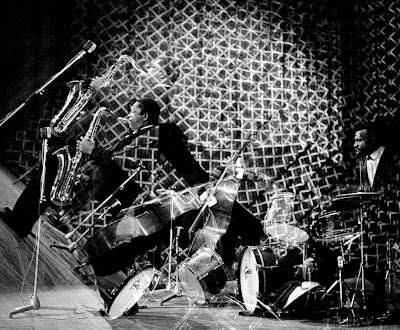
Jazz Of Thufeil - Coltrane - Garrison - Tyner - Jones.jpg
Artistic Retouched Photo of Coltrane's Dream Quartet

After listening to various musicians, Coltrane put his dream quartet together 1961. With the solid double bassist Jimmy Garrison as pivotal figure, the drummer Elvin Jones developed a poly-rhythm that implied, rather than stated, the tempo; and into this tumultuous undertow McCoy Tyner's piano repeated tireless motifs that lured the soloist into a trance. Tyner's intentional harmonic uncertainties invited Coltrane to multiply the melodic phrases. One mode followed another, mixed, ground down, saturated with notes jostling each other until they overlapped, for a 'multiphonic' effect. Occasionally the tempo even disappeared altogether, diluted in long incantatory recitatives, such as the last section of love supreme.
More and more often, Coltrane preferred to omit the piano and double bass and remain alone with the energy flow transmitted by Elvin Jones.

Jazz Of Thufeil - Pharoah Sanders.jpg
Pharoah Sanders


Some young members of the avant-garde of free jazz, who worshiped Coltrane, were invited to participate in the recording of the influential album Ascension,and one of them, Pharoah Sanders (tenor sax), began to play with him regularly after that. Soon Coltrane rid himself of McCoy Tyner's piano, which he had begun to see as standing in his way.

Jazz Of Thufeil - Ali Coltrane.jpg
Rashied Ali and John Coltrane perform

 Elvin Jones left, too, in reaction to the arrival of the drummer Rashied Ali, whose conceptions of free jazz he did not share. Coltrane died on 17 July 1967, finally having attained the end of his quest for the upper limits of both fame and music. Throngs of musicians of every type remain haunted by the influence of his work to this day.

____________________