John Coltrane was the master of modern jazz in the early sixties. He was a leader for angry young black musicians who wanted to re-appropriate their music from the dominant white culture. Against a background of the civil right movement, jazz musicians rejected the aesthetic criteria of mainstream American society and invented something new that would be called free jazz.
 |
| John Coltrane |
The saxophone player John Coltrane
was a calm, reserved, contemplative man, completely absorbed by his
music and, even more, by the philosophical and mystical problems he
sought to solve through his music. Although annoyed by Coltrane's
incessant questions, Miles Davis asked him to join his quintet in 1956.
Perhaps he understood that one of the great figures of jazz would emerge
from these interrogations. From his first steps with Davis until his
death, Coltrane never stopped questioning his art.
 |
| (L-R) John Coltrane, Cannonball Adderley, Miles Davis and Bill Evans; Kind Of Blue Recording Session |
With Giant Steps
In
1957, during a stint at the Five Spot in New York City with the
Thelonious Monk Quartet, Coltrane was inspired by the unusual piano
accompaniments. When Monk would leave the stage, Coltrane would take
advantage of this time to explore new harmonic processes during long
improvisations.
In 1958 Coltrane joined Miles Davis' new sextet, which recorded his masterpiece,
Kind of Blue,
a year later. Coltrane's playing had changed: from this point on he
produced absolute torrents to sound. He brought his reflections on chord
progressions to an end while recording 'Giant Steps', the ultimate
outcome of the harmonic system of bebop, with his quartet. Thereafter he
pursued his quest in the direction of modal jazz. In the meantime, even
side by side with Miles Davis, he became increasingly alienated, and
his long solo flights seemed to come from another universe.
 |
| Jimmy Garrison |
The Ascension
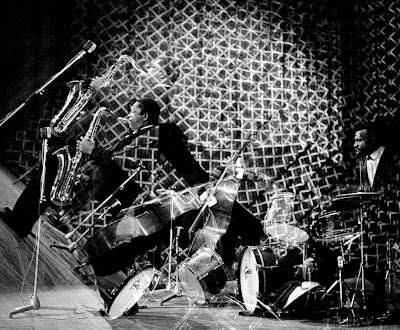 |
| Artistic Retouched Photo of Coltrane's Dream Quartet |
After
listening to various musicians, Coltrane put his dream quartet together
1961. With the solid double bassist Jimmy Garrison as pivotal figure,
the drummer Elvin Jones developed a poly-rhythm that implied, rather than
stated, the tempo; and into this tumultuous undertow McCoy Tyner's
piano repeated tireless motifs that lured the soloist into a trance. Tyner's intentional harmonic uncertainties invited Coltrane to multiply
the melodic phrases. One mode followed another, mixed, ground down,
saturated with notes jostling each other until they overlapped, for a
'multiphonic' effect. Occasionally the tempo even disappeared
altogether, diluted in long incantatory recitatives, such as the last
section of
love supreme.
More and more often, Coltrane
preferred to omit the piano and double bass and remain alone with the
energy flow transmitted by Elvin Jones.
 |
| Pharoah Sanders |
Some young members of the
avant-garde of free jazz, who worshiped Coltrane, were invited to
participate in the recording of the influential album
Ascension,and
one of them, Pharoah Sanders (tenor sax), began to play with him
regularly after that. Soon Coltrane rid himself of McCoy Tyner's piano,
which he had begun to see as standing in his way.
 |
| Rashied Ali and John Coltrane perform |
Elvin Jones
left, too, in reaction to the arrival of the drummer Rashied Ali, whose
conceptions of free jazz he did not share. Coltrane died on 17 July
1967, finally having attained the end of his quest for the upper limits
of both fame and music. Throngs of musicians of every type remain
haunted by the influence of his work to this day.
____________________


