Showing posts with label Paul Bley. Show all posts

A Certain Need For Space & ECM Aesthetics


Jazz- rock continued to satisfy the youthful public well into the eighties, despite the fact that admirers, the press and even the musicians wearied of it. At the end of seventies, John McLaughlin and several others returned to the virtues of the acoustic guitar.


Jazz Of Thufeil - John McLaughlin acoustic.jpg
John McLaughlin on acoustic guitar


Instrumental stereotypes and the somewhat vain virtuosity of jazz-rock guitar players were specifically called into question. The reaction came from the musicians themselves. An airier tone, a more limpid melody, a lighter orchestral context - these qualities were sought after as musicians listened to their elders: Wes Montgomery, Jim Hall and Bill Evans. But they wanted to mix their own culture - pop songs and country music- in with this. Guitar players John Abercrombie and Pat Metheny found the space their aspirations required at the record label ECM.


Jazz Of Thufeil - Wes Montgomery.jpg
Wes Montgomery


ECM Aesthetics

'Editions of Contemporary Music' : the identity crisis of jazz at the time was captured in the very name of this label, which did not even dare to name the music it presented. German Manfred Eicher, a former bassist, established ECM in 1969. He was first noticed for seeking to capture a sound reminiscent of the acoustics of a concert hall rather than that of smoky club. The technical enhancements ECM employed - precision of the stereo sound and reconstitution of the echo, and the crystal-clear renderings of instruments such as the piano, the vibraphone, and the electric and acoustic guitars - displeased old discophiles but responded to what young public concerned with a certain ease in listening (even at the expense of authenticity) was waiting for.

Jazz Of Thufeil - John Abercrombie.jpg
John Abercrombie
  
Jazz Of Thufeil - Pat Metheny.jpg
Pat Metheny

Later generations, disappointed by the crumbling of revolutionary ideologies and the exhaustion of the avant-garde, have focused on defending the environment and reviving the classics. ECM  and the innumerable labels that fell in step with it suggested a new 'ecology' of recording and concert giving. The return to the acoustic piano was magnified by the solo formula, until that point still  fairly exceptional in modern jazz. Solos by Keith Jarret or Paul Bley and duets by Chick Corea with Herbie Hancock or Gary Burton publicized a chamber music. The jazz musicians now became a concert artist, and jazz concert benefited by being listened to as seriously as recitals of classical music.


Jazz Of Thufeil - Paul Bley.jpg
Paul Bley


Jazz Of Thufeil - Gary Burton.jpg
Gary Burton

____________________

'A Barroom Piano Player'


This is how Bill Evans was appraised when free jazz exploded. Later, the critics realized that circumspectly and without being the leader of any particular current, he had led as profound a revolution as John Coltrane or Ornette Coleman. Without ever systematizing the contributions of modal jazz (which he helped found), he drew deep inspiration from it. His work as a composer surely borrowed from his charms of the old standards, of which he was very fond; but he lightened their often limited harmonic frames and broadened the field of melodic possibilities.
  
Jazz Of Thufeil - Bill Evans  beard.png
Bill Evans


More significantly, due to the quality of his touch, he inaugurated a new approach to the jazz piano, which, until that point, had primarily been used as a percussion instrument. Bill Evans was not a barroom piano player; he was a concert pianist. His trio (piano, double bass, drums), which he used as a chamber orchestra, broke new ground.
  
Jazz Of Thufeil - Scott LaFaro Bill Evans Paul Motian.png
Scott LaFaro, Bill Evans, Paul Motian


From 1960 to 1961, Scott LaFaro (bass) and Paul Motian (drums) freed themselves from their role as mere accompanists and became soloist on an equal footing with the piano; the three participated in a triangular conversation. Collective and interactive, improvisation became more than ever a question of mutual listening and finding one's own place while treating the others' with respect. The revolution led by John Coltrane with sound and fury was conducted by Bill Evans' trios with a delicacy that evoked the intimacy of Claude Debussy.

jazz Of Thufeil - Steve Swallow, Walter Perkins, Art Farmer, Jim Hall.png
(L-R) Steve Swallow, Walter Perkins, Art Farmer, Jim Hall
  
Thus, along with such contemporaries as Jim Hall, who shared his concerns, Bill Evans left his mark on generations of musicians: on pianist, of course (Keith Jarret, Paul Bley and Chick Corea), but also on drummers (Jack DeJohnette), bass players (Gary Peacock), and saxophone players, trumpet players and bandleaders.
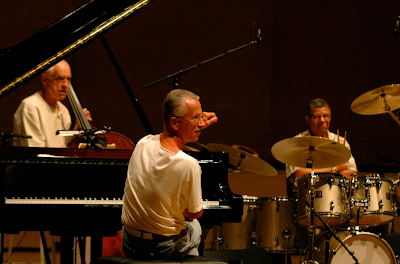
Jazz Of Thufeil - Gary Peacock, Keith Jarret, Jack deJohnette.png
Gary Peacock, Keith Jarret, Jack DeJohnette (2012)

____________________