Though
an American form, jazz, of course, does have practitioners outside the
United States. France, especially, has embraced jazz since its earliest
days; it can be said that it all began there with Django Reinhardt in
the thirties. Ending France's isolation during World War II, the
American troops arrived in 1944, and the first bebop records were not
long in following. For more than fifteen years there was no safe haven
outside of bebop or New Orleans orthodoxy. Such rare exceptions as
Martial Solal or Andre Hodeir only proved the rule.
 |
| Django Reinhardt |
With the
explosion of free jazz, however, everything suddenly became possible. In
Europe it became fashionable to reject the criteria of' 'old-fashioned
jazz' at the same time that 'bourgeois' art was being decried.
 |
| Mike Westbrook |
Throughout Europe, those rare big bands that were still active abandoned
formal dress for blue jeans and left their platforms to mix with each
other in an informal alignment that sometimes moved into a fanfare to
the audience.
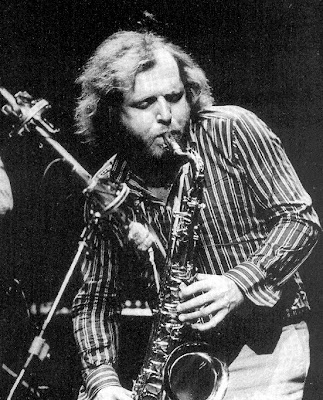 |
| Willem Breuker |
The roles inside the band were also called into
question, and some small groups went so far as to do without a rhythm
section altogether, others reduced themselves to a duo. If such changes
were a response to the economic difficulties free jazz - which was not
very marketable - encountered, they were also one way of exploring
special affinities on a more intimate dramatic scale. With such
musicians as Mike Westbrook and Willem Breuker, these 'stagings'
sometimes took on true dramatic form.
____________________


